Tuesday, July 22, 2014

New Study: Cloud Benefits


Since my last few posts were kind of down on the cloud (that sounds like a horrible song title) I thought I would look up an article to discuss that was about cloud benefits.  The article I found was written by Shawn Drew and was published on Midsize Insider. You can read the full thing HERE.

The article talks about a new study that was done by the Harvard Business Review and published in FORBES. The article sums up the study with two words agility and simplicity. The cloud offered those responding to the study the ability to change market conditions and explore new opportunities while making day to day operations less complex.

One of the more interesting things about the study was that it was not a study of cloud enthusiast but rather a wide selection of everyday business people. Some of whom viewed the cloud with "caution". The article then relates back to its main focus which is midsized business.


I found this article refreshing. It was nice to read something about the cloud that was a little more up-beat. I love to hear how real users of a technology view it, that is a much better endorsement than anything in our text book could be. 

Wednesday, July 16, 2014

Cloud of Darkness: Fake Apps

I just finished this week's discussion board assignment and it has me a little down on the cloud. To summarize I realized that I have a program that I spend $400 and have been using somewhat often for 8 years. The new version of this program is a cloud app that costs $19.99/month. If a user wants to use it for 8 years they will pay nearly $2000. This got me a little grumpy and I wrote a long discussion post about how the cloud was a scheme for big business to make money. I know there are a lot of benefits to the cloud but a negative fits my mood better so let’s talk about fake apps.

The nifty icon from the top of the article

In a new article on PC World, Martyn Williams discuses fake apps. The article can be read HERE. The banner headline "There are almost a million fake apps targeting your phone". That was a catchy title as I scrolled through the RSS feeds on the right. The article talks about a new study from Trend Micro.

The study found that nearly 77% of the apps in the Google app store have a fake version that is actually malware. This fake versions run like the real app but they are stealing data. Many of these are fake anti-virus apps. The study also talks about how one app was downloaded frequently with the aide of bots and became highly rated app.  Google announced that it was looking into such problems but the announcement coincidentally came the same day that Trend Micro released it study.

My first reaction is not one of surprise. I knew that malware for phones and tablets had to be out there but I had not heard about it. My new rule: If the technology exists there is malware for it or there soon will be. My second reaction was relief that I my mobile devices do not use the Google app store.


Google needs to be very careful how they handle this. The large number of malicious apps in their store could drive a lot of users away.

Wednesday, July 9, 2014

The Cloud: Not Ready for Prime Time?


This week we had to do a discussion board question about the cloud and privacy issues. Researching this question led me to some pretty interesting articles about the cloud. Our text book covers what the cloud is and a lot of the reasons to use the cloud, many of the articles I found this week talked about why companies are not using the cloud and what needs to change for them to do so. I thought I would focus my blog post on one of these articles that did not really relate to privacy but was and interesting read. The article was from eweek.com and can be found HERE. The article was called Five Trends Show Why Cloud Computing Is Far From Mature.

The five trends discussed in the article are:
1.       Transparency
2.       Regional and Smaller Clouds
3.       The Hybrid Narrative
4.       Incompatible Clouds
5.       The Internet of Things that Don't Talk to One Another

To briefly summarize the trends: Transparency is a pretty simple concept to understand, it is hard to figure out cloud pricing.  With some of the privacy issues popping up users are starting to care about what country their data is stored in this is creating smaller clouds. The Hybrid Narrative refers to the mash up of cloud services and in house applications that are not a "seamless infrastructure model". Incompatible Clouds is pretty self-explanatory.  The final point refers to the advent of sensor based digital world that may not be growing as fast as vendors are hoping. If you would like more details please check out the article Eric Lundquist did a really nice job explaining everything in an easy to read manner.


My thoughts on the article are mixed. First of all there are a few issues that I had no idea existed which makes having an opinion on them hard but besides that the article is really saying that the cloud might be a bit overhyped and while it might be the way of the future it still has some developing to do before we get there. I have to agree with this overall message and from reading the discussion board for the class many of fellow students agree. I read a number of posts about how they would not trust their personal data to the cloud, which makes it hard for them to recommend it for a business.  The cloud is definitely something to keep an eye on but it does not seem like it is ready for mass usage and giant switch overs. 

Monday, July 7, 2014

The Cloud & Work: Telework

This week will be a little strange. This week 5 post was not due until week six, because of the 4th of July. During that time I began looking at jobs in my area (only 5 weeks until I graduate) and sadly enough only found 2 within driving distance. Those are not good odds. I did a little research and found a new area to look in to. Telework. Telecommuting. Work from home. They are all names for the same thing and until recently they included customer service positions and little else. The cloud is changing that and is allowing me to apply for jobs all over the country. It is also a cloud based concept that I have been researching heavily over the past week.


The benefits to an employee are pretty obvious, flexible work schedule, not having to commute, not having to change out of their "jammies", etc. But there are also benefits for employers as well: improved productivity, increased employee happiness, expanded talent pool, and it saves employers money. For those of you who love cold hard statistics HERE is website with some numbers for you and HERE is another one. Enjoy.
From my own personal experience I have found ten more jobs to apply for which I believe is a 500% increase in the number of jobs I will be applying for I am not a lover of cold hard statistics so that figure might be wrong. But applying for 12 jobs instead of 2 has to increase my odds of getting a position. My biggest surprise has been how many government jobs can be done remotely. If you go to https://www.usajobs.gov/ to look at government jobs and type in telework and then narrow it down to the category Information Technology you come with 38 jobs. 


These jobs are all over the board. You see the Departments of Justice, Defense, the Treasury, Transportation, and Veteran Affairs in just the first dozen. As you can imagine an entry level technician such as myself is not qualified for the most of the positions but they do account for four of the jobs on my new list of ten.

Telework is providing me with opportunities that I would not have otherwise had and that is due to the cloud. This seems to be a wave of the future and is something that many IT people should keep an eye on, as the flexibility provided by these positions could be a major benefit and add to the happiness of their lives.


Monday, June 23, 2014

Legal Issues: Streaming Video Cloud Services

So this week I decided to change it up a little and write a post about something that was not in the text book. I found in the news feeds on the left right here on my very own blog (which was why I put all those feeds on there to begin with).


The article was pretty interesting and can be found HERE. To summarize the whole thing it is about Aereo and the legal case against it. Aereo is "…a video-streaming service that streams over-the-air broadcast television channels to iOS devices like the iPhone and iPad, and various browsers on Macs and PCS…"

The legal case against Aereo is if they are infringing on copyright laws. Many of the large broadcast companies are claiming that what Aereo is doing in rebroadcasting their content which is illegal. Aereo claims that it has installed enough antennas that there is one available for every customer and seems to liken itself to other providers such as directv and dish network, just using a different format.

The court case is a big one and will effect what kind of content cloud providers can allow online so it is a pretty big deal. Other cloud service providers that are already on the fringe of legality such putlocker have to be watching very closely.


My personal take on it is that Aereo is providing a new way to access the same content and I hope that the courts find in their favor. Putlocker on the other is a little different. Going to their website (careful if you click the link, there are a lot of pop ups and my Norton flagged one) I found Edge of Tomorrow available for viewing which won't even be out on DVD until October. There were a number of other movies available that are not even out on DVD. I do not see how this could possibly be legal.


Anyway both issues should be fun to keep track of in the future.

Tuesday, June 17, 2014

Week 3: Transparency and Flexibility

This week we learned about quite a few different topics as it relates to the cloud. The textbook went over using the cloud as alternative to traditional technology and gave some examples which were very interesting. The text covered Platform as a service and implementing infrastructure as a service.

Two big topics for this week: transparency and flexibility.  If it helps just remember the Fantastic Four, the Invisible Woman and Reed Richards with the power to stretch his body all over the place. It is a slightly different when talking about the cloud (just a little).

Promotional art for Fantastic Four #509 (March 2004)
by Mike Wieringo and Karl Kesel.
Retrieved from:http://en.wikipedia.org/wiki/File:FF509.jpg 
Transparency refers to a user's experience. Was it seamless? Could you tell that it was a cloud based service instead of a traditional program. Cloud based services should be transparent; users should not even realize they are using the cloud except in some abstract manner. Flexibility, just as it sounds, is about how versatile the cloud can be, you can use it anywhere, you can use it at any time, etc.


One final note, I have much more experience with the cloud than I had first thought. Those dumb little games on my Ipod and on http://www.kongregate.com/ are all cloud services. I guess I knew that but did not put it all together in my head.  

Thursday, June 12, 2014

Week 2: Cloud Models

This week I took a little while trying to come up with a topic. I am still a little unsure of what is covered by the blanket term "cloud computing" is it makes it kind of hard to choose a blog topic. This week our text talked about different types of cloud models so I figured this would be a great topic for my blog post. I used https://www.computenext.com/blog/when-to-use-saas-paas-and-iaas/ for a source this week.There are three basic models of cloud services SaaS, PaaS, and IaaS (Software as a Service, Platform as a Service, and Infrastructure as a Service).


Software as a Service

Software as a Service as the name implies is software that you can use without downloading it to your computer. This is the one most people are familiar with and is the only one I have ever personally used. SaaS applications include Google Apps and Dropbox and Gmail the only cloud service mentioned in any of this week's readings that I have actually used.  I do think many of my apps on my IPOD would fall into this category as well but none of them were mentioned in any of the readings for the week. The graphic above from the computernext website was very helpful for me in separating the three cloud models. You buy Saas services.

Platform as a Service

Platform as a service is more about development and deployment of software. These services include virtual environments that developers can use to test the programs and apps they create. I have no experience at all with this type of service and to be honest did not really know they existed on the cloud. In this model a computing platform is provided. Our graphic above says that you deploy PaaS

Infrastructure as a Service

This final model was the hardest for me to get my head around it seems to include a lot of different things. It includes computer resources such as servers, processing power, storage and networking.  Our graphic above says that you build IaaS which kind of makes sense. Personally I am going to think of this one as "virtual hardware", including virtual PCs.  
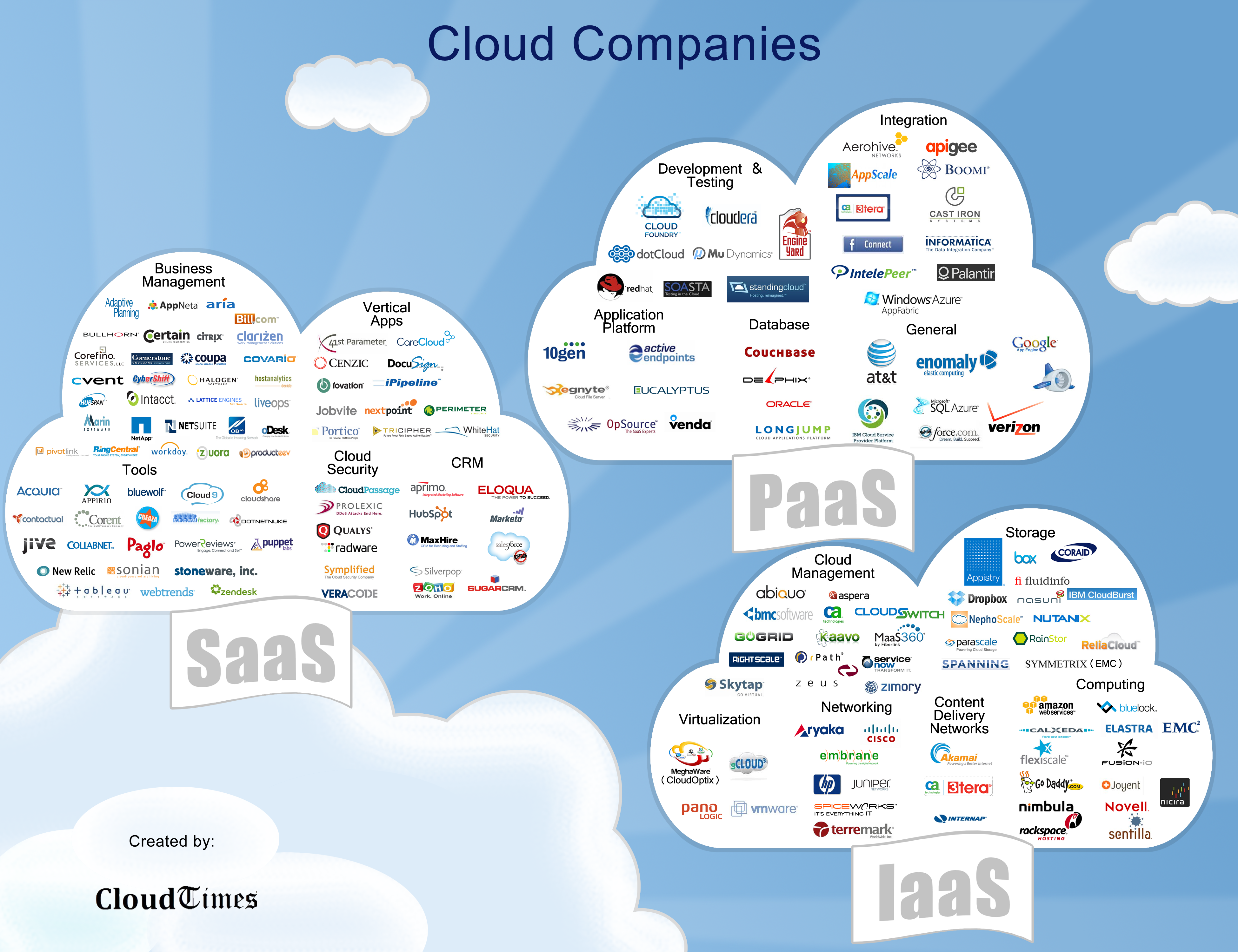
While the concepts behind these models are not hard, they are new terms that I am still wrapping my head around. I am looking forward to learning more about them. I found this graphic on cloudtimes.org which lists quite a few cloud service companies separated by which model they belong to.